
Words, Words, Words
Because May is the first month of our calendar year without the letter “R,” I decided to vent about my disappointment with writers and speakers no longer using the word “are.” What happened? I have a theory, which I will mention at the end, but first, here are some examples that I have heard or read, and then I’ll mention a couple of guides to help us (me, included).
- “There’s been eight months since . . .”
- “There is always going to be growing pains …”
- “There’s situations that come up…”
- “There’s always been flashes…”
- “There’s problems with . . .”
- “There’s a lot of people . . .”
Here is (are? 🤔) what I discovered.
The issue is the noun that follows “there’s” – is it a noun that is a “collective” noun? A single word that refers to more than one thing? Like class and group? Did you know that those nouns use singular verbs? I figured that these collective nouns were one of the problems, so I looked more at the examples I collected. But, first, here is a definition of a “collective” noun.
A noun that is singular in form but refers to a group of people or things.
Here are some other examples: audience, bunch, crowd, flock, gang, staff – you get the idea.
Even though it seems as if I should use a plural verb like “are” for nouns that refer to multiple people or things, apparently, I should just go with the fact that collective nouns need a singular verb like “is.”
HINT!!! A lot of confusion comes from the fact that the collective nouns are followed by a prepositional phrase beginning with of!!!
So . . . in my examples above – “There is a lot of people” qualifies. “Is” IS correct? Yes. Even though the word people describes more than one person, the word lot is a collective noun, so it needs a singular verb. Therefore, “is” IS good in this example.
Note to self: I need to ignore the noun in the prepositional phrase and focus on the noun after the verb. And then I need to understand that, even though that noun might indicate more than one person or thing, if it’s a “collective” noun, I need use a singular verb.
EXTRA HINT!!!!! Look for “a” or “an”!! A or an are used as articles indicating a . . . wait for it . . . a singular noun!!! Whoo hoo!
“There is a lot of people” gives me both examples – the word “a” and the word “lot” (ignoring the noun “people” in the “of” prepositional phrase). YAY! I think I’ve got it!
My other examples, like “There’s situations”???😞👎!
- Now, here’s my sociological theory why we don’t say “there are” anymore? Saying “there’s” is a LOT easier (physically) than saying “there’re.”
There’re is REALLY difficult to say and has fallen out of use. Saying both words – “there are” – would fix the problem, but that means we would have to say 2 syllables instead of 1.
Waah… 😭 It’s much easier to say 1 syllable. We have become lazy speakers in many ways, and this is just one example.
Happy May (without an “R” 😉).
From The Blog
When a Third-Party is involved in a Real Estate Purchase, Caution is Needed for Purchasers and Closers
According to an article in the Wall Street Journal, the number of parents who are contributing in some way to their children’s purchase of a…
HR “Speak” – Part Two
In my October, 2025, blog post (“HR” Speak – BB’s Words), my HR expert friend, Maggie Peters, gave me some language that HR people use…
Animal Groups
In honor of National Pet Month (May), here are words for groups of animals (in case you want to adopt several animals 🤗🥰.) Did you…
Books from Barbara P. Burke
Mr. Smiles® Stories
(Also available in Spanish)
-
How Mr. Smiles® Got His Name
$8.00 Select options This product has multiple variants. The options may be chosen on the product page -
Mr. Smiles® and the Power of Smiles
$8.00 Select options This product has multiple variants. The options may be chosen on the product page -

Mr. Smiles® and the Listening Lesson
$8.00 Select options This product has multiple variants. The options may be chosen on the product page -
Mr. Smiles® and Changing Cruel to Cool
$8.00 Select options This product has multiple variants. The options may be chosen on the product page -
Mr. Smiles® and the Spend or Save Question
$8.00 Select options This product has multiple variants. The options may be chosen on the product page
Title World Tales™

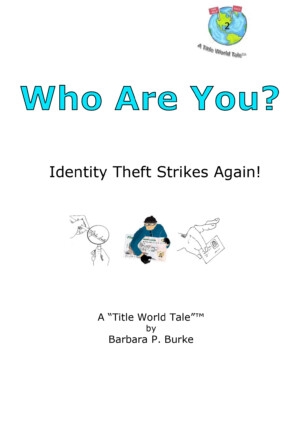

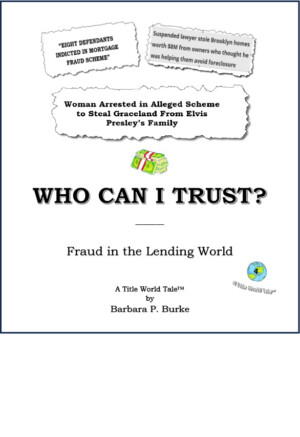
More Great Books
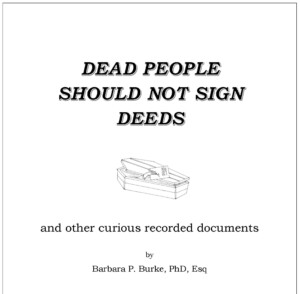

Persuasive Communication™ Training
Do you have a lot of thoughts but can’t seem to put them together? As the “Thought Connector,” Dr. Burke will help you organize your thoughts to best convey your message to your customers or clients.